Oct 29, 2026News & Insights
AGM vs GEL Battery: Which One Fits Your Solar Storage Project?
Both are sealed VRLA, but AGM and gel charge and age differently and suit different duty cycles. A buyer-level comparison of charge voltage, cycle life, heat tolerance and cost per usable kWh.
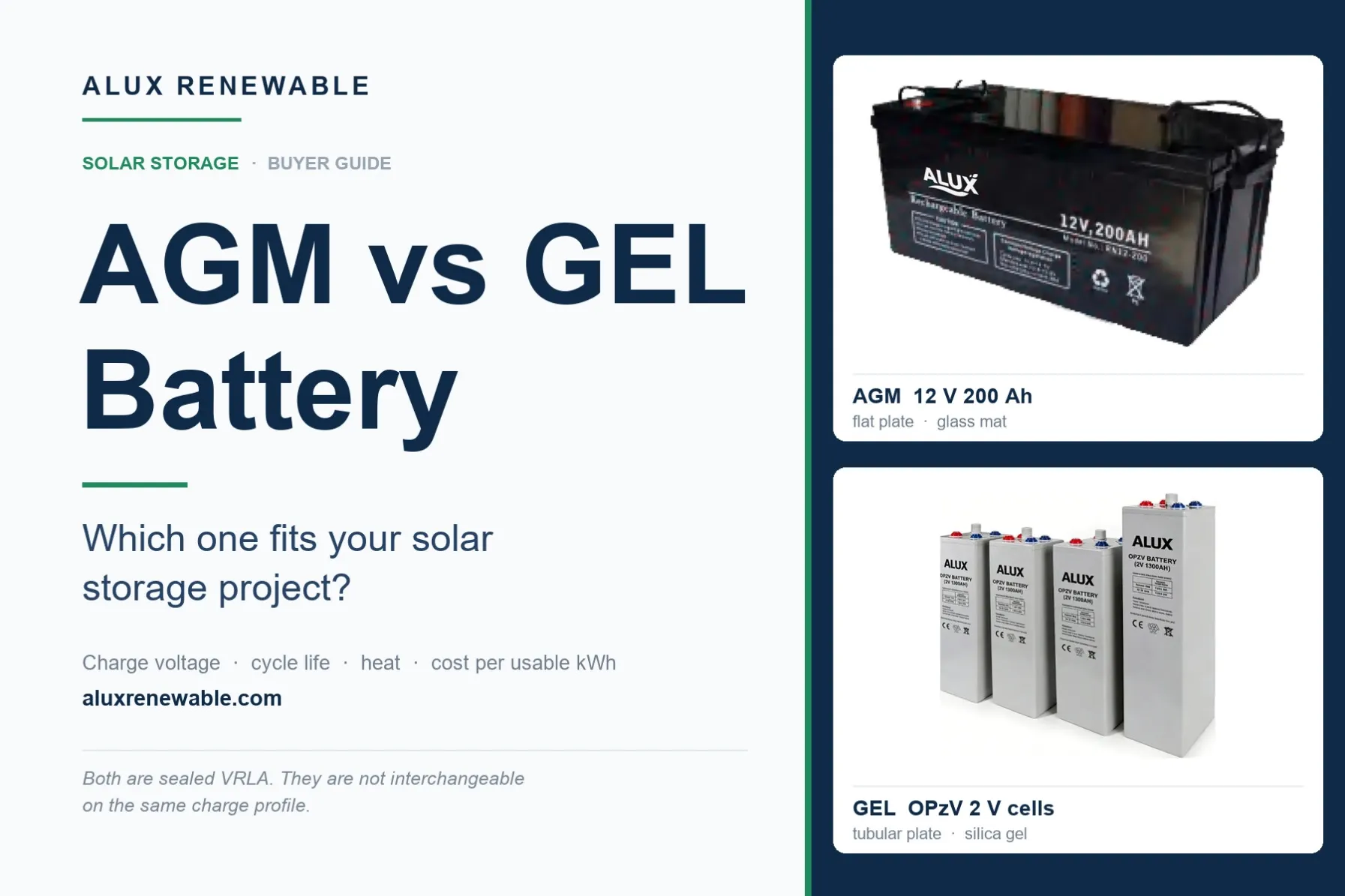
Quick answer
AGM and gel are both sealed VRLA lead-acid batteries, so the choice is not "old versus new" - it is a choice about charge tolerance, cycle depth and heat. If the site has a programmable charger and the battery will be cycled deeply every day in a hot climate, gel (including OPzV tubular gel) is usually the better fit. If the load is high-rate, recharge time is short, the charger cannot be reprogrammed, or capex is tight, AGM is usually the better fit.
Most sourcing mistakes on solar battery projects do not come from picking the wrong brand. They come from buying a gel block and charging it on an AGM profile, or from comparing a float-life figure with a cycle-life figure and treating them as the same number. This guide sets out what actually differs between the two constructions, and what to put in a request for quotation so the supplier quotes against the real duty cycle.
What AGM and gel have in common
Both are valve-regulated lead-acid (VRLA) batteries. The electrolyte is immobilised, the case is sealed, and the safety valve only opens under abnormal pressure. In normal use neither type needs water topping-up, acid level checks or specific-gravity measurement, and both can be installed in most orientations because there is no free liquid to spill.
Both are also lead-acid at cell level: the same 2 V cell chemistry, assembled as 6 V or 12 V blocks, or as 2 V cells for larger stationary banks. That means both share the same weaknesses: they are damaged by over-discharge, they lose service life quickly as ambient temperature rises, and they need a proper multi-stage charge profile rather than a fixed output.
The construction difference that drives everything else
In an AGM battery the electrolyte is absorbed in a boron-silicate glass microfibre mat that is compressed against the plates. The mat holds the acid in place and leaves gas paths open, so oxygen can recombine internally. Because the acid is held in a thin, saturated layer against the plate, internal resistance is low and the battery accepts charge quickly.
In a gel battery the acid is thickened with fumed silica into a thixotropic gel that fills the space between the plates and separators. The gel does not stratify the way liquid acid does, which is an advantage in tall cells and in cyclic service. The trade-off is higher internal resistance: the battery accepts charge more slowly, delivers less burst current, and is far less forgiving of an over-voltage charge.
That single difference - low resistance and a wide voltage window versus high resistance and a narrow one - explains most of the practical guidance that follows.
Charge voltage: the number that decides how long the battery lasts
On a 12 V block, AGM absorption voltage is typically set in the 14.4 V to 14.8 V range, with float around 13.5 V to 13.8 V. A gel block is typically set lower, in the 14.0 V to 14.4 V range, with a float of roughly 13.5 V to 13.7 V. Equalisation charging, which is occasionally applied to deep-cycle AGM, is not recommended for gel.
These are common industry setpoints, not a rule for every model. The datasheet for the exact block governs, and the setpoint must be temperature-compensated: a charger programmed for 25 degrees C will overcharge a cold battery and undercharge a hot one.
The gel window is narrow for a physical reason. Over-voltage drives gas formation inside the gel. The gas forms pockets, the gel pulls away from the plate, and the contact area lost that way never comes back. A battery that has been charged on an AGM profile for a season can lose a large share of its rated capacity with no visible damage from outside.
If the charge controller on site cannot be programmed to a gel profile, buy AGM. This is not a preference - it is the single most common cause of premature gel failure in off-grid systems.
Float life and cycle life are different numbers
Most lead-acid datasheets quote a design float service life: the life expected when the battery sits on continuous charge and is only occasionally discharged. Our ALX12-200 12 V 200 Ah AGM block, for example, carries a 7-year design float life at 20 degrees C. Our 2 V 300 Ah OPzV gel cell carries an 18 to 20 year design float life at 25 degrees C. Neither figure is a cycle count.
Cycle life is what matters in a solar bank that discharges every night, and it depends on depth of discharge, discharge rate, end-of-discharge voltage, ambient temperature and the charge profile. Published ranges across the industry are wide: roughly 400 to 600 cycles at 50 percent depth of discharge for general-purpose AGM, and roughly 600 to 1,000 or more for quality deep-cycle gel designs. Treat any single cycle number as valid only for the test conditions printed next to it.
This is where a buyer can separate suppliers quickly. A datasheet that gives float life but no cycle data, no test depth of discharge and no temperature is not a comparison document. Ask for the test conditions before you compare prices.
Deep discharge, recovery and daily cycling
Gel designs generally tolerate deeper and longer discharge better, because the gel supports the active material and the thicker plate designs used in deep-cycle gel and OPzV constructions shed material more slowly. Our OPzV 2 V cells are specified to recover to about 95 percent of rated capacity after 12 hours of deep discharge, which is the kind of figure that matters on a remote site with several days of poor weather.
AGM deep-cycle grades also recover well from occasional deep discharge, but they are happiest with shallow cycling and a prompt recharge. On both types, designing the bank to about 50 percent average depth of discharge for daily cycling, and 30 to 40 percent where you want margin, will do more for service life than any brand choice.
Heat: the real life limiter in Africa, the Middle East and Latin America
A widely used rule of thumb for VRLA batteries is that service life is roughly halved for every 8 to 10 degrees C of sustained operating temperature above 25 degrees C. A battery room running at 40 degrees C can cut a 7-year float design to about half of that, whatever the label says.
Gel has a genuine edge here. The gelled electrolyte distributes and dissipates heat better than a glass mat, and OPzV cells are typically specified for ambient ranges up to 35 to 70 degrees C. But no lead-acid chemistry escapes the heat rule. Shade the bank, ventilate the enclosure, keep it off a metal roof, and specify temperature-compensated charging. Buyers in hot markets should treat thermal design as part of the battery specification, not as an installation detail.
Cost: purchase price versus cost per usable kilowatt-hour
Gel blocks normally cost more per amp-hour than AGM of the same capacity, and they are heavier per amp-hour, which raises freight cost per kilowatt-hour shipped - a real line item for an importer. Against that, gel's longer cycle life can reduce replacement frequency in daily-cycling off-grid systems, and replacement on a remote site usually costs more than the battery.
The comparison that holds up is cost per cycle and cost per usable kilowatt-hour over the design life, using the depth of discharge the site will actually run. In standby and UPS duty, where the battery rarely cycles, the longer gel cycle life delivers little, and AGM is normally the better value.
Choosing between them: a short decision list
Choose AGM when
The load includes high-rate or short-duration discharge, such as inverter start-up or a pump motor. The array is large and recharge time is short, so high charge acceptance matters. The charger or inverter is not programmable to a gel profile. The climate is cool, or the battery sits in a conditioned room. The budget is fixed and the duty cycle is moderate.
Choose gel when
The bank discharges deeply every day, the site is hot, and the design life target is ten years or more. The site is remote enough that a replacement visit is expensive. The bank is built from 2 V cells at higher capacity, where OPzV tubular gel is the standard construction.
Consider LiFePO4 when
Weight and usable capacity dominate. Our LFP12-100 12.8 V 100 Ah LiFePO4 block stores 1,280 Wh at about 10.5 kg, against 29.3 kg for our ALX12-100 12 V 100 Ah AGM block of similar footprint, and it is rated for more than 5,000 cycles at 50 percent depth of discharge with an integrated BMS. The trade-offs are a higher purchase price and a restriction that matters in cold markets: LiFePO4 must not be charged below 0 degrees C.
OPzV: the gel option for larger solar banks
OPzV is the construction most buyers mean when they ask for a large gel battery. The positive plate is tubular rather than flat, the separator is microporous PVC-silica, and the electrolyte is gel. Tubular plates retain active material far better under deep cycling, which is why OPzV cells are the usual choice for telecom, large off-grid and utility-adjacent solar banks, in capacities from 200 Ah to several thousand amp-hours at 2 V. Our published OPzV range covers 2 V 200 Ah, 2 V 300 Ah and 2 V 600 Ah cells.
OPzV is not a drop-in replacement for a 12 V AGM block, though. A 2 V cell bank has to be assembled, braced and connected as a string, and the charge profile must be set for gel. Plan the rack, the inter-cell connectors and the commissioning checks as part of the order, not after it.
What to send with your quotation request
Suppliers quote what you ask for, so the accuracy of the quotation depends on the brief. For a solar bank, send: nominal system voltage and the block or cell size you want; bank configuration in series and parallel, with the total energy in kilowatt-hours; daily load profile and average daily consumption; days of autonomy required; the depth of discharge you are designing to; ambient temperature range at the site; charger or inverter model, and whether its profile can be programmed; terminal type and orientation; the destination market and the certification documents required there; and expected annual volume.
With those inputs a supplier can propose a matched configuration and quote against a real duty cycle instead of a catalogue price. If you are comparing two offers, ask both for the same three documents: the datasheet for the exact model, the cycle-life test conditions, and the charge profile they recommend for your controller.
To request a quotation for AGM, gel, OPzV or LiFePO4 batteries for your market, contact the ALUX Renewable team through the contact page with the details above.
Frequently asked questions
Can I charge a gel battery with an AGM charger?
Not safely. AGM absorption voltage is typically higher than the gel window, and sustained over-voltage forms permanent gas pockets in the gel. Either reprogram the charger to the gel setpoints on the battery datasheet, or use an AGM battery on that charger.
Is gel better than AGM for solar?
It depends on the duty cycle, not on the label. Gel is usually better where the bank is cycled deeply every day, the site is hot, and a long design life matters. AGM is usually better where recharge is fast, the load is high-rate, the charger is fixed, or the budget is the deciding constraint.
Do gel batteries need a special charge controller?
They need a controller whose absorption and float voltages can be set to the gel values, with temperature compensation, and no equalisation stage. Many MPPT controllers offer a gel preset; verify the actual voltages against the battery datasheet rather than trusting the preset name.
What is the difference between gel and OPzV?
Gel describes the electrolyte. OPzV describes the whole construction: a tubular positive plate, a PVC-silica separator and gel electrolyte in a 2 V cell. All OPzV cells are gel, but not all gel batteries are OPzV - most 12 V gel blocks use flat plates.
Which type lasts longer in a hot climate?
Gel generally holds up better in sustained heat because the gelled electrolyte manages heat better and the construction is more tolerant of high ambient. But both types lose life quickly above 25 degrees C, so enclosure ventilation, shading and temperature-compensated charging matter as much as the chemistry choice.