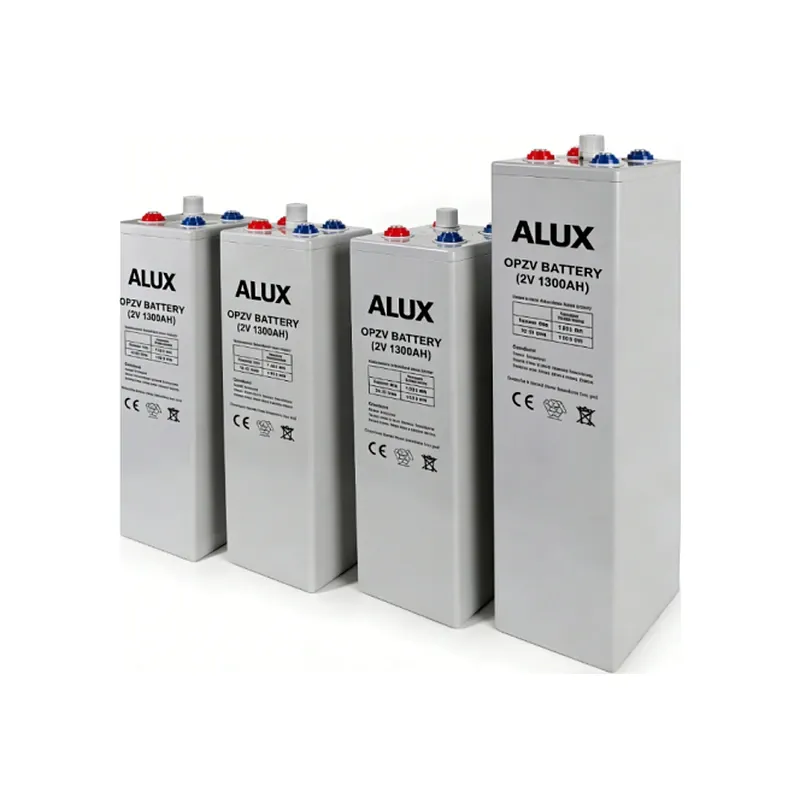
Lead Acid Battery Solution
ALUX OPzV 1000Ah 2V Tubular Gel Battery (OPzV1000)
ALUX OPzV 1000Ah 2V Tubular Gel Battery (OPzV1000) is a 2 V 1,000 Ah tubular gel battery in a 233 × 210 × 647 mm case weighing 73 kg, rated for deep-cycle duty in telecom, UPS and substation standby. Dimensions, terminal type and weight are listed in the specification table.
Product Overview
The ALUX OPzV1000 is a 2 V 1,000 Ah OPzV tubular gel cell, 233 × 210 × 647 mm over the case (688 mm including terminals) and weighs 73 kg. Tubular positive plates with a lead-tin-calcium alloy grid hold the active material in place, which is what gives OPzV blocks their life in long-duration discharge and in cabinets running at 35–70 °C. Cells are series-connected into 12 V, 24 V or 48 V strings, with 4 M10 × 20 terminals per cell for connector bars.
Key Features
- Tubular positive plates — die-cast lead-tin-calcium alloy grids with tubular sheaths hold the active material in place and slow down corrosion, which is what sets life in long-duration duty.
- Gel electrolyte — fumed-silica gel immobilises the acid, so tall cells do not stratify and the battery is maintenance-free and spill-proof.
- High-temperature tolerance — stable performance in cabinets and shelters running 35–70 °C, where AGM blocks would dry out.
- Low-resistance microporous separator — keeps internal resistance low for high-current discharge as well as long, slow discharges.
- High-strength ABS container — moulded case rated for stationary installation and transport.
- Bolt terminals — threaded posts with the terminal count shown in the table for string wiring.
Technical Specifications
Specification | OPzV1000 |
Model | OPzV1000 |
Nominal voltage | 2 V |
Nominal capacity | 1,000 Ah |
Chemistry | Tubular gel valve-regulated lead-acid (VRLA) |
Length | 233 mm |
Width | 210 mm |
Height | 647 mm |
Total height (incl. terminals) | 688 mm |
Terminal type | M10 × 20 |
Terminal count | 4 |
Weight | 73 kg |
Container | High-strength ABS |
Typical Applications
- Telecom BTS and core sites
- UPS and data-centre strings
- Solar and wind hybrid microgrids
- Substation control and protection
- Emergency power and EPS systems
- Railway and metro signalling
- Security and fire-alarm panels
- Outdoor cabinets at 35–70 °C