News & Insights
How to Size a Solar Battery Bank (With Worked Examples)
A five-step solar battery bank sizing method for installers and importers: daily load, days of autonomy, depth of discharge, system losses and voltage — with two worked examples.
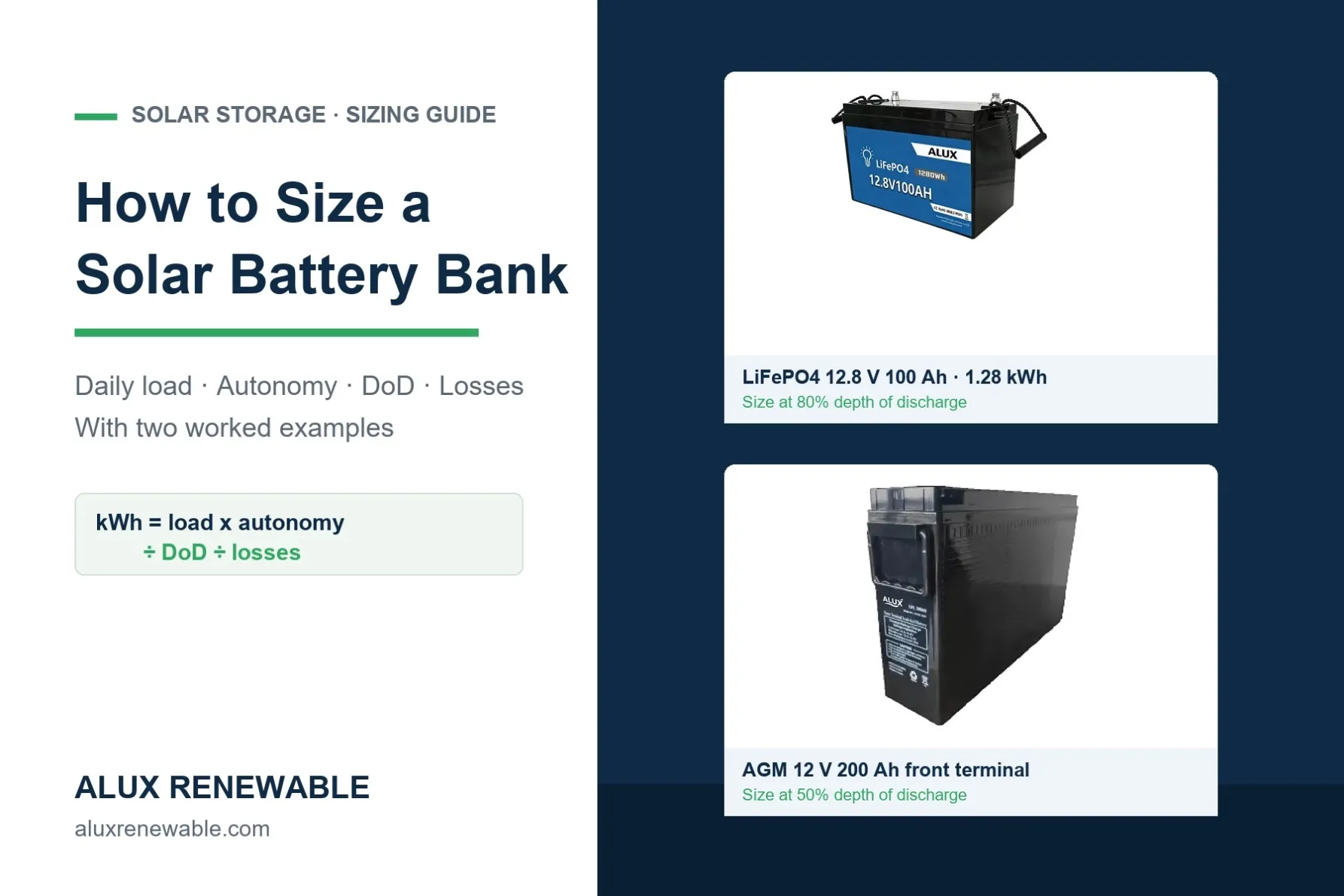
A battery bank is usually the most expensive line item in an off-grid or hybrid solar project, and it is the component customers judge first when something goes wrong. A bank that is too small runs flat halfway through the night; a bank that is too large ties up budget and warehouse space, and — with lead-acid chemistry — can stay chronically undercharged if the solar array is not sized to match. Solar battery bank sizing is therefore not a detail to leave to the last minute: it drives cost, shipping weight, installation footprint and the number of units on every quote you send.
This guide walks through the five-step sizing method our team uses when quoting distributors, installers and EPC contractors, followed by two worked examples — one lead-acid bank built from 12V 200Ah AGM batteries, one LiFePO4 bank built around a 51.2V 300Ah module. The arithmetic is simple, but each step has a common mistake attached to it.
Step 1: Start With Daily Energy Use, Not Power Ratings
The starting point is the daily load: the total energy the batteries must supply in one day, measured in kilowatt-hours (kWh). It is calculated from a load audit, not from the inverter size or the panel array:
Appliance energy (kWh) = rated watts × running hours per day ÷ 1,000
A shop running a 150 W chest freezer for 10 hours, 60 W of lighting for 6 hours, and a router, phone chargers and a small TV drawing roughly 0.4 kWh combined needs about 2.5 kWh per day. A family home with a refrigerator, fans, lighting and a washing machine typically lands between 5 and 8 kWh per day depending on the region and season.
The most common error at this step is quoting from the inverter rating ("a 5 kW system") instead of the measured load. Power rating describes how much can run at once; the battery bank is sized on energy consumed over 24 hours. Always ask for the load audit table before quoting a configuration.
Step 2: Decide the Days of Autonomy
Days of autonomy is how many consecutive days the bank must carry the load with no solar input. Grid-backup systems are typically designed for 1 day; off-grid systems in stable sunny climates for 1.5–2 days; off-grid sites with a distinct rainy or monsoon season for 2–3 days. The capacity requirement scales almost linearly with this number, so it is where most of the budget conversation with the end customer happens — better before the order than after the first complaint.
Step 3: Apply Depth of Discharge (DoD)
No battery should be routinely emptied to 0%. Depth of discharge is the share of nameplate capacity you actually plan to use, and it is dictated by chemistry and the manufacturer's cycle-life data:
Lead-acid batteries (AGM, gel, OPzV) in cyclic solar duty are normally sized around 50% DoD. LiFePO4 batteries are commonly sized at 80% DoD, and some models allow more — always confirm against the specific datasheet rather than a generic rule.
DoD is applied as a divisor, and it is the single biggest difference between the two chemistries on a quote:
Required nameplate capacity (kWh) = daily load × days of autonomy ÷ DoD
The same 10 kWh of usable energy needs 20 kWh of rated lead-acid but only about 12.5 kWh of rated LiFePO4. This is why a lithium bank can cost more per kWh of nameplate capacity and still win the project on total cost, weight and floor space. (How AGM and gel differ from each other within the lead-acid family is a separate question — we cover that in our AGM vs GEL comparison.)
Step 4: Add System Losses
Two efficiency factors sit between the load and the battery terminals. The inverter converts DC to AC at roughly 85–95% efficiency depending on model and loading. The battery's own round-trip efficiency is around 80–85% for lead-acid and 90–95% for LiFePO4. Both are applied as divisors:
Nameplate capacity = (daily load × autonomy) ÷ DoD ÷ inverter efficiency ÷ round-trip efficiency
Skipping this step leaves a bank that is 10–20% short from day one. Use the actual figures from the inverter and battery datasheets for the final quotation rather than generic values.
Step 5: Convert kWh to Amp-Hours at the System Voltage
Battery capacity is labelled in Ah, so the last step converts energy to amp-hours at the system voltage:
Ah = kWh × 1,000 ÷ system voltage
For systems above roughly 3 kWh/day, 48V is the practical standard: it keeps current, cable size and voltage drop manageable. 12V and 24V banks remain common for small shops, lighting systems and RV-scale projects. A 15 kWh 48V bank is about 312 Ah — a very different cable conversation from the same energy at 12V (1,250 Ah).
Worked Example 1: A 48V Lead-Acid Bank for a Small Off-Grid Shop
Load audit result: 4 kWh/day. Two days of autonomy. AGM chemistry at 50% DoD, inverter efficiency 90%.
Usable energy: 4 × 2 = 8 kWh. Applying DoD: 8 ÷ 0.50 = 16 kWh. Applying inverter losses: 16 ÷ 0.90 ≈ 17.8 kWh of nameplate capacity.
At 48V that is 17,800 ÷ 48 ≈ 371 Ah, so a 400 Ah bank is the nearest practical size. Built from ALUX 12V 200Ah AGM batteries, that is four units in series (48V) with two parallel strings — eight batteries, 19.2 kWh installed, which gives a small operating margin. For projects that prefer front-terminal connections in cabinets, the same capacity point is available as the ALUX 12V 200Ah front-terminal AGM.
Worked Example 2: A 48V LiFePO4 Bank for a Family Home
Load audit result: 5.8 kWh/day. Two days of autonomy. LiFePO4 at 80% DoD, inverter efficiency 95%.
Usable energy: 5.8 × 2 = 11.6 kWh. Applying DoD: 11.6 ÷ 0.80 = 14.5 kWh. Applying losses: 14.5 ÷ 0.95 ≈ 15.3 kWh of nameplate capacity.
The nearest standard configuration is one 51.2V 300Ah 15 kWh LiFePO4 battery — 15.36 kWh, a near-exact match. Wall-mounted, floor-standing, rack and stackable formats in the 5–30 kWh range cover the rest of the residential spectrum, which is why most home storage quotes today consolidate into one or two large lithium modules instead of a 40-piece lead-acid array. For smaller 12V loads, the 12.8V 100Ah LiFePO4 deep cycle battery (1.28 kWh per unit) is the equivalent building block. The load audit said 15.3 kWh and the module offers 15.36 kWh — acceptable because audits tend to overestimate, but if the site has a heavy seasonal load, size on the worst month, not the annual average.
Temperature, Ageing and Operating Margin
Battery capacity is rated at a standard temperature (usually 25°C). Lead-acid banks deliver noticeably less usable capacity in cold climates, and standard LiFePO4 packs without low-temperature charging protection must not be charged below 0°C — check the BMS specification before quoting cold-region projects, and either plan a heated enclosure or add 10–20% rated capacity as margin.
Ageing matters too: a lead-acid bank sized exactly to its new-capacity numbers will be undersized by year three or four. Size on end-of-life capacity — what the datasheet still guarantees at the designed cycle count — rather than on the ship-out figure.
Five Sizing Mistakes That Generate Complaints
First, sizing on rated capacity and forgetting DoD — a "10 kWh" lead-acid bank delivers 5 kWh usable. Second, quoting one day of autonomy for an off-grid site that clearly needs two. Third, ignoring inverter and round-trip losses, which quietly removes 10–20% of the design. Fourth, planning to "add batteries later": mixing new batteries with old ones in the same lead-acid bank drags the whole bank to the oldest unit's condition, so the final bank size should be decided up front. Fifth, upsizing the bank without checking that the solar array can recharge it within the available sun hours — a chronically undercharged lead-acid bank sulfates and fails years early.
Frequently Asked Questions
How many batteries do I need for a 5 kWh daily load?
With two days of autonomy: LiFePO4 at 80% DoD and 95% efficiency needs about 13.2 kWh — roughly 260 Ah at 51.2V. Lead-acid at 50% DoD and 90% inverter efficiency needs about 22.2 kWh — roughly 460 Ah at 48V, or twelve 12V 200Ah batteries in a 4S3P arrangement.
Can I mix old and new batteries in the same bank?
Not recommended. In a lead-acid bank the oldest unit defines charging behaviour for the whole string and pulls the newer batteries down with it. In a LiFePO4 system, only parallel packs with the same model, capacity and BMS firmware generation should be combined, following the manufacturer's paralleling limits.
Does a bigger battery bank need a bigger solar array?
Yes. As a rule of thumb the array should replace a full day's consumption plus charge the bank within the local peak-sun hours. A bank charged by an undersized array never reaches full charge, which shows up later as capacity loss — especially in lead-acid.
What DoD should I use for gel or OPzV batteries?
Tubular OPzV cells are designed for deep cyclic duty and tolerate deeper daily cycling than flat-plate AGM, but the exact permitted DoD is defined per model in the manufacturer's cycle-life curves. Use the datasheet curve at your target cycle life, not a single generic number.
Should I quote lead-acid or LiFePO4 for the project?
Price both on delivered usable kWh and on lifetime cost per kWh, not on nameplate price. Lead-acid still wins many budget-constrained, high-autonomy installations; lithium wins on space, weight, cycling and maintenance. Comparing them at equal usable energy is the only fair basis.
Get a Bank Configuration for Your Project
If you are a distributor, installer or EPC contractor preparing a quotation, send our team the load audit, autonomy requirement and system voltage — we will come back with a bank configuration from the ALUX AGM, gel, OPzV and LiFePO4 ranges, matched to your target price point. Contact the ALUX Renewable team for configurations and wholesale pricing.