News & Insights
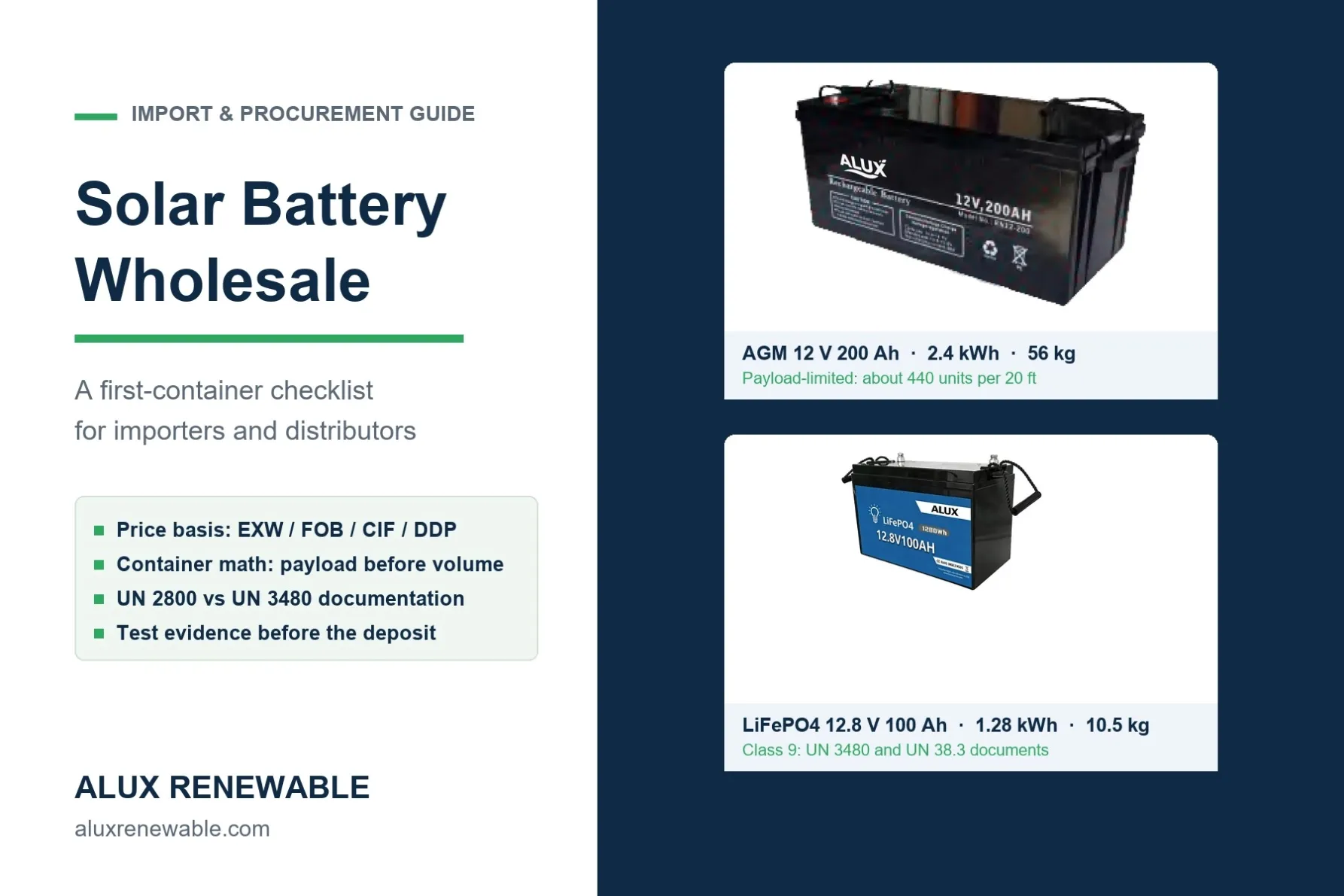
Solar Battery Wholesale: A First-Container Checklist for Importers
A wholesale checklist for solar battery importers: price basis, the chemistry mix, container weight math, UN 2800 vs UN 3480 documents, and what to verify before the deposit.
Why most wholesale quotations are not comparable
Almost every solar battery quotation an importer receives looks the same on the surface: a unit price, a model number, a lead time. The differences that decide whether the order makes money sit underneath — which Incoterm the price is built on, which quantity tier it assumes, how the goods are packed, and what test evidence comes with them.
Two suppliers can quote the same 12 V 200 Ah AGM battery at prices that look 8% apart and still be quoting two different products: one price may be EXW with loose cartons and no pallet, the other CIF with palletised export packing, a test report and a warranty document. Neither is wrong. They are simply not the same offer.
A wholesale price is only comparable inside a defined basis: same Incoterm, same quantity tier, same packaging, same test scope.
This guide sets out the sequence a distributor or EPC buyer can follow before committing to a first container of solar batteries — what to define, what to calculate, and what to verify.
Step 1 — Define the order in kWh, not only in units
Distributors think in pallets and SKUs, because that is how stock is counted. Margin, however, is earned per kilowatt-hour moved, and freight is paid per kilogram or per cubic metre. An order defined only in units hides both numbers.
Take a typical mixed first order and convert it:
Four hundred ALX12-200 units is 960 kWh and roughly 22.4 tonnes before pallets. The same 960 kWh in LFP12-100 is 750 units and about 7.9 tonnes. Same stored energy, one third of the weight — and a completely different freight line, container plan and customs file.
Step 2 — Choose the chemistry mix your market actually resells
Lead-acid: AGM, GEL and OPzV
AGM remains the volume product in most emerging solar markets because it is understood by installers, available in every capacity class, and cheap to replace. The 12 V 100 Ah to 12 V 250 Ah range, plus front-terminal 12 V 100–200 Ah models for telecom and rack cabinets, covers most residential and small commercial work. If you are still deciding between the two lead-acid families, our AGM vs GEL battery comparison sets out the charging voltages and cycling behaviour that separate them in the field.
GEL and OPzV sit above AGM where cycling is deeper and ambient temperatures are higher. OPzV uses tubular positive plates and a gelled electrolyte, which is why it is the usual choice for telecom sites, off-grid villages and utility-scale solar in hot climates. It is sold as 2 V cells for larger banks; a 24-cell string of 2 V 600 Ah cells gives a 48 V, 28.8 kWh bank, and the cell format makes individual cell monitoring practical.
LiFePO4: the premium line, not a replacement for everything
LiFePO4 is lighter, tolerates deeper discharge and is rated for far more cycles than lead-acid, but it needs a compatible charger and inverter, a working BMS protocol, and a customer who understands the price difference. The practical first-container approach is to keep lead-acid as the volume base and add one or two LiFePO4 SKUs — a 12.8 V 100 Ah drop-in and a 51.2 V rack or wall unit — as a trial line rather than a full switch.
Whichever mix you choose, the rule is the same: the order should be defined by what your installers ask for repeatedly, not by what the supplier's price list makes most attractive.
Step 3 — Run the container math before you negotiate price
Weight, not volume, limits lead-acid
A 20 ft general-purpose container holds roughly 33 m³ and carries about 28 tonnes of payload; a 40 ft high-cube holds about 76 m³ and carries roughly 26–27 tonnes. For lead-acid batteries the payload limit arrives long before the volume limit.
On ALX12-200 at 56 kg, a 20 ft container runs out of payload at around 500 units, while the same box could physically hold more than 1,200 by volume. Allowing for pallets and stowage losses, plan on roughly 420–450 units. A 40 ft high-cube does not help much: its payload limit lands near 470 units, so the extra cubic metres are mostly air. For heavy lead-acid, the 20 ft container is frequently the better box.
At 29.3 kg, ALX12-100 is still weight-bound: about 950 units by payload against a volume ceiling above 2,600, so plan on roughly 880–900 units.
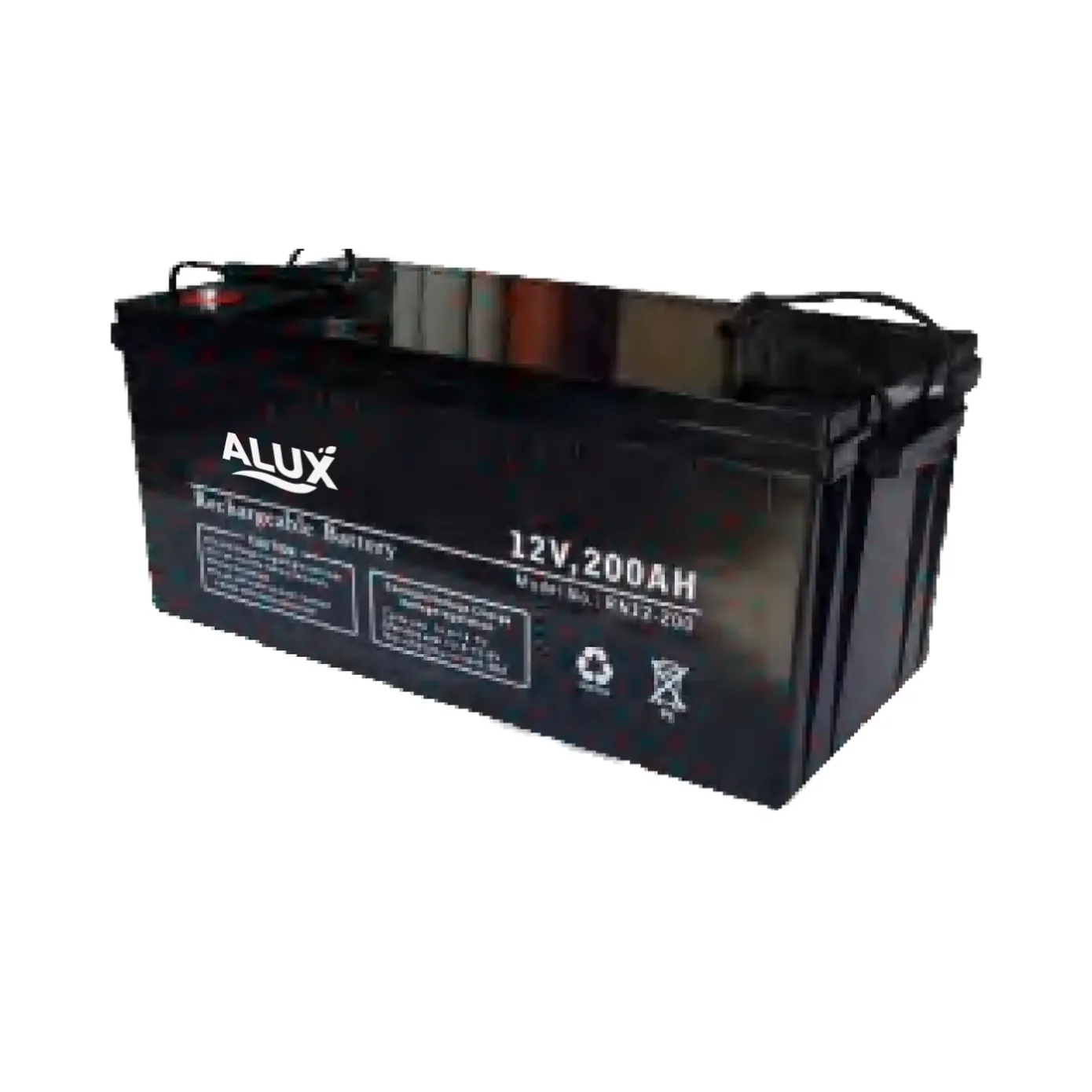
ALUX ALX12-200 12 V 200 Ah: 56 kg per unit, so payload runs out long before volume does.
LiFePO4 changes which limit binds
LFP12-100 at 10.5 kg is close to balanced: payload allows about 2,600 units in a 20 ft container and volume allows about the same. Once export cartons, pallets and Class 9 stowage requirements are added, expect materially fewer. This is the point where the forwarder's loading plan matters more than the catalogue.
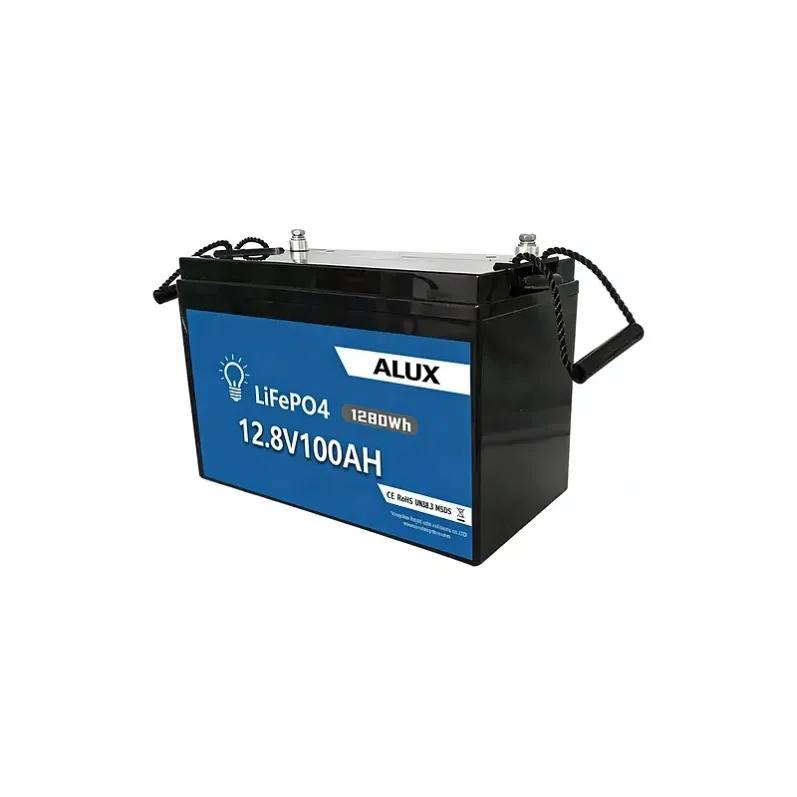
ALUX LFP12-100 12.8 V 100 Ah: 10.5 kg per unit, close to balanced between payload and volume.
Freight per kWh is the number that decides margin
Expressed per tonne of freight, ALX12-200 delivers about 43 kWh, while LFP12-100 delivers about 122 kWh — roughly 2.8 times more stored energy for the same sea freight weight. On long routes to South America or West Africa, that gap can outweigh the higher unit price of lithium. It is also why lead-acid works best when it is sourced close to its end market, or bought in full containers rather than in LCL shipments.
All figures above are planning estimates based on published ALUX dimensions and weights, assuming standard export packing. Actual loaded quantities depend on pallet configuration, carrier payload limits and route restrictions, and should be confirmed with your forwarder before the order is placed.
Step 4 — Confirm the transport classification in writing
Battery classification is not a detail to leave to the freight forwarder after the order is placed, because it changes packing, booking and documents.
VRLA batteries — AGM, GEL and OPzV — are non-spillable electric storage batteries, classified under UN 2800. Special Provision 238 allows them to move as non-restricted cargo when three conditions are met: they withstand the specified vibration and pressure-differential tests without leakage, the electrolyte will not flow from a ruptured case at 55 °C and there is no free liquid, and the terminals are protected against short circuit in the export packaging. The exemption depends on that test evidence and on the carrier accepting it; it is not automatic because a datasheet says "non-spillable".
LiFePO4 batteries are lithium-ion batteries, UN 3480, Class 9. Sea shipments are packed to P903; air shipments carry a state-of-charge limit of 30%. They require a UN 38.3 test summary and a lithium battery mark on the package.
For customs, lead-acid batteries usually fall under HS 8507.20 and lithium-ion under HS 8507.60. Confirm the national tariff line at destination before quoting a landed cost to your own customers.
Step 5 — Verify documents before you pay a deposit
A supplier who can answer technical questions but cannot produce documents is a risk, not a bargain. Ask for the following and check the certificate numbers against the issuing laboratory's database:
For lithium: UN 38.3 test summary per cell and pack model, MSDS, IEC 62619 for industrial storage, and IEC 62133-2 where the product is marketed as portable.
For lead-acid: IEC 61427-1 for renewable-energy cycling duty, IEC 60896-21 or -22 for stationary VRLA, and a written non-spillable declaration with the test reference behind it.
For both: a quality management certificate, a model-specific datasheet with dimensions, weight, internal resistance and charge-voltage limits, a warranty statement that defines what is covered and how a claim is processed, and a packing list that matches the pallet plan.
If a supplier sends a certificate with a different model number than the one quoted, treat the whole quotation as unverified until it is corrected. It also helps to know what the production line actually does: our walk-through of the lead-acid battery manufacturing process explains the stages that decide plate quality, and therefore how much capacity variation to expect across a container.
Step 6 — Sample, then a pilot pallet, then the container
A sample proves the product exists. A pilot pallet proves the supplier can pack, label and document consistently. The container order is where all three have to hold at once.
A workable sequence for a first order is: two to four sample units for capacity and charge-voltage checks; one pallet with production labels, packaging and manual; then the container, with a pre-shipment inspection that includes a capacity test on random units and a check that serial numbers match the packing list.
Step 7 — Terms worth writing into the purchase order
The quotation is a marketing document; the purchase order is the contract. Put these in it explicitly: quantity tolerance, model and capacity per line, packaging and pallet configuration, label and OEM scope, warranty period and claim procedure, spare-parts allowance, production lead time, inspection standard and who pays for it, document set required for clearance, and the Incoterm with the named port.
Two clauses are worth more than they cost to negotiate: a definition of what counts as a failed unit (for example, capacity below a stated percentage of rated value at a stated discharge rate), and a replacement mechanism for units that fail inside the warranty period. Without both, a warranty is only a sentence.
Red flags in a wholesale quotation
A unit price well below the rest of the shortlist, with no explanation of cell grade or packing. A datasheet that lists capacity but not dimensions, weight or charge voltages. Reluctance to send a sample before a deposit. A "10-year warranty" with no capacity threshold or claim process. Photographs of a factory that reverse-image-search to another company's website. And any supplier who answers a question about UN 38.3 with "no problem, we ship every week".
FAQ
What is the normal MOQ for solar battery wholesale?
There is no single industry figure. MOQ depends on whether the model is standard or OEM, the capacity and enclosure, and whether the order is a sample, a pallet or a container. Ask for three numbers separately — sample MOQ, pallet MOQ and container MOQ — because pricing usually changes at the container tier, not at the pallet tier.
Is a 40 ft container cheaper per battery than a 20 ft for lead-acid?
Usually not for heavy 12 V blocks. On 56 kg batteries the payload limit is reached at roughly 470–500 units whether the box is 20 ft or 40 ft, so the larger container adds freight cost without adding much load. Compare cost per unit loaded, not cost per container.
How many 12 V 100 Ah LiFePO4 batteries fit in a 20 ft container?
By weight and by volume, roughly 2,600 units are theoretically possible at 10.5 kg and 0.012 m³ each. With export cartons, pallets and Class 9 stowage the practical figure is lower; ask your forwarder to confirm against the actual packing plan.
Do VRLA solar batteries need dangerous goods documentation?
They are classified under UN 2800 and are commonly exempted from Class 8 when they meet the non-spillable test requirements of Special Provision 238 and terminals are protected. The exemption still requires a declaration, an MSDS and carrier acceptance — confirm it before booking.
Can I mix lead-acid and LiFePO4 in one container?
Yes, but the two chemistries carry different documentation and handling requirements, and a mixed booking is more work for the forwarder. If the lithium quantity is small, shipping it as a separate LCL consignment is sometimes simpler than combining it with a full container of lead-acid.
Planning a first container?
Send us the load profile your market actually buys — capacities, quantities, destination port and target landed cost — and we will come back with a suggested model mix, a loading estimate for the container you intend to book, and the document list you will need at destination. Alux Renewable works as a China-based supply partner for distributors, installers and EPC contractors, so the answer is built around your order rather than a price list.