News & Insights
OPzV vs OPzS: Choosing a Tubular Battery for Solar and Telecom
OPzV and OPzS share the same tubular plate. Compare maintenance, battery room, charge window, heat behaviour and costs — plus the RFQ and incoming checks that make quotes comparable.
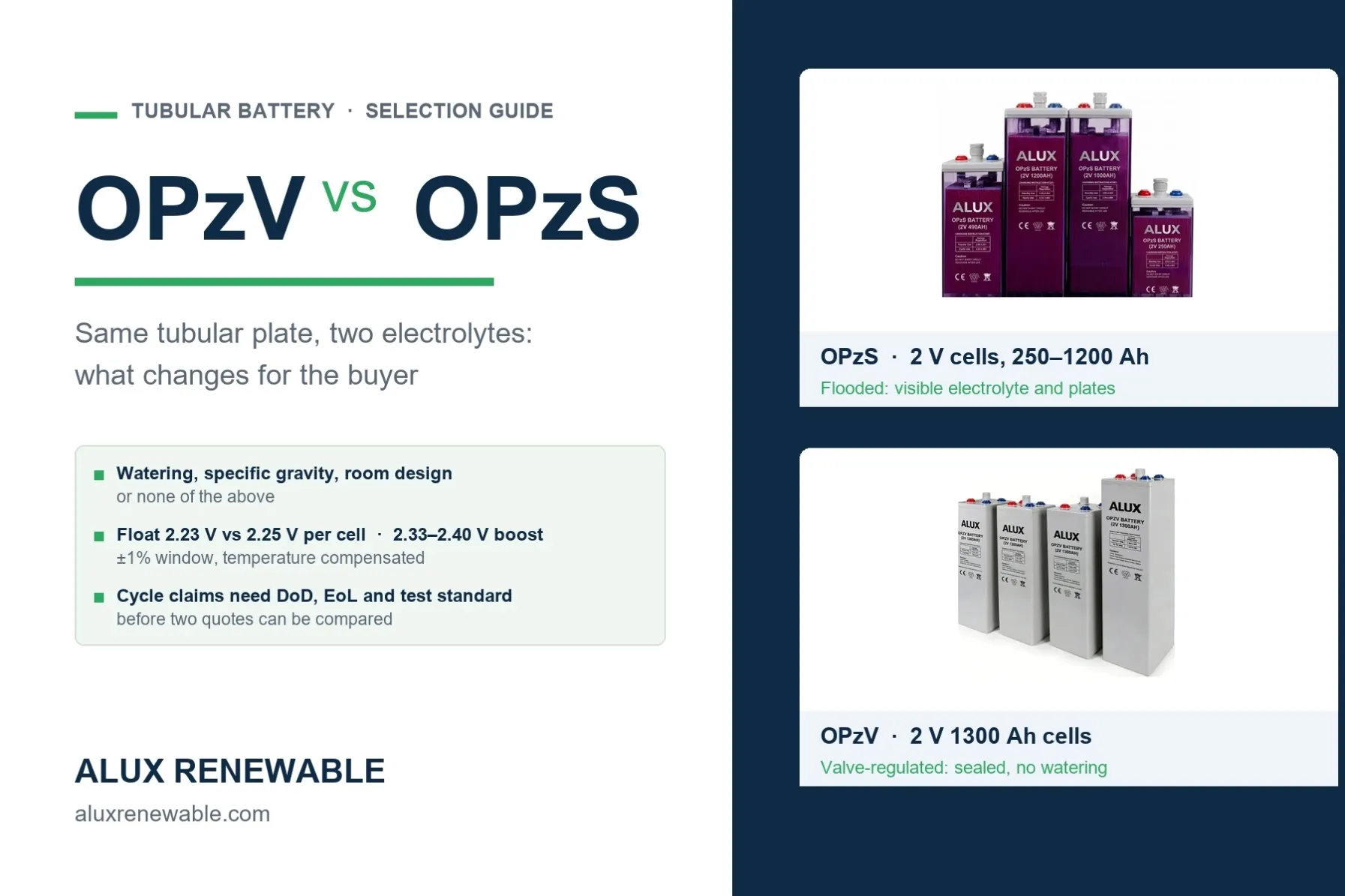
OPzV and OPzS cells are both 2 V stationary lead-acid batteries built on the same tubular positive plate. What separates them is how the acid is held inside the case — and that one decision cascades into who has to visit the site, what the battery room must look like, how precise the charger has to be, and how you inspect the bank three years after commissioning.
Most comparisons of OPzV vs OPzS stop at a table of electrolytes and cycle-life claims, then end with a product recommendation. This one starts from site conditions and from the questions you can put to a supplier, so the choice survives a tender review and can be checked again at delivery.
What the letters mean
The designation is German and descriptive. O is Ortsfest — stationary. Pz is Panzerplatte — the tubular positive plate, where active material is held inside porous tubes wound around a lead alloy spine instead of being pasted onto a flat grid. The final letter is where the two families part.
S — Säure, liquid acid. An OPzS cell is vented and flooded, specified under DIN 40736, with caps that let you read and top up the electrolyte.
V — verschlossen, sealed. An OPzV cell is valve-regulated (VRLA) with the acid immobilised in fumed-silica gel: no free liquid, no water to add in normal service.
Both are long-duration deep-cycle designs, typically 100 Ah to several thousand Ah per 2 V cell, assembled into 24 V, 48 V or 110 V strings. The plate gives both families their cycling life; the electrolyte decides the operating model around them.
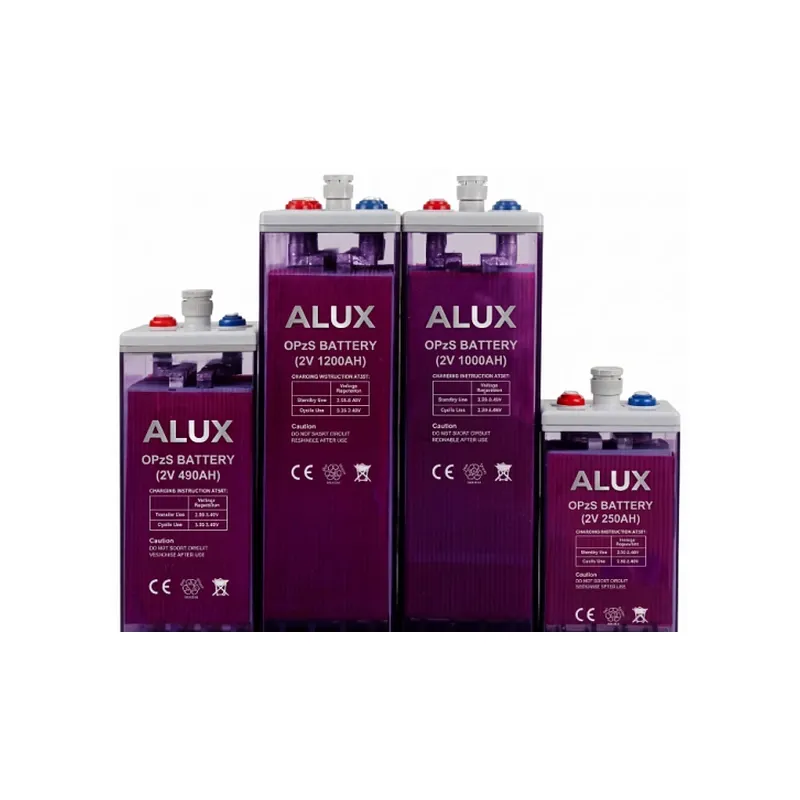
ALUX OPzS flooded tubular cells: transparent cases show electrolyte and plate condition; vent caps allow topping up and specific-gravity readings.
Side by side, on the points that change a specification
OPzS — flooded tubular. Liquid acid · vented caps · water top-up and specific gravity readings · upright only · battery room with hydrogen ventilation and spill containment · float around 2.23 V per cell at 20 °C.OPzV — valve-regulated tubular gel. Immobilised gel · sealed case with pressure relief valve · no watering, no specific gravity reading · horizontal installation possible if the manual allows it · low gassing, but still needs airflow and thermal control · float around 2.25 V per cell at 20 °C.
Note how close the float voltages are. The gel cell does not need a different voltage from a flooded one; it needs a steadier one.
Why the published cycle-life figures do not line up
Search for OPzV vs OPzS and you will find cycle counts in the 1,500 to 2,500 range at 80% depth of discharge quoted for both families — and supplier tables where the ranking reverses, one page putting OPzS higher, the next putting OPzV higher.
The numbers are not necessarily wrong; they answer different questions. Four test conditions move the result more than the electrolyte does: depth of discharge (80% and 50% DoD give very different counts from one cell), the end-of-life criterion (80% of rated capacity or 60% — the lower figure flatters the count), the test temperature, and the discharge rate and end voltage (C10 to 1.80 V per cell is a different duty from C3 to 1.75 V).
The standard matters too: stationary vented cells are tested to IEC 60896-11, valve-regulated cells to IEC 60896-21 and -22, and solar cycling duty to IEC 61427-1. A supplier who names the standard, the DoD and the end-of-life criterion gives you something comparable. A single number without them is a slogan.
What actually changes on site
Who waters the cells, and how often
On float in a temperature-controlled room, OPzS cells are typically topped up on a cycle measured in years — two to three years is a common figure in manufacturers' guidance — and much more often in a hot room or on daily deep cycling. Water loss tracks how hard the cells are being overcharged.
Watering is a procedure, not a chore: distilled water only, correct level, volume recorded per cell, specific gravity compared with the design value (1.240 kg/l for standard DIN tubular cells, lower for hot-climate variants). It also takes someone trained to notice a cell drinking noticeably more than its neighbours, which is usually the first sign of failure.
OPzV removes the task and the diagnostic together. There is no specific gravity to read, so cell health has to come from float voltage, ohmic trends and periodic capacity tests. If nobody will run those tests either, "maintenance-free" buys less than the brochure implies.
The room itself
A flooded bank produces hydrogen on charge and needs a ventilation calculation (IEC 62485-2 is the usual basis), an acid-resistant floor, spill containment and eyewash provision — civil costs that never appear on the battery quotation. OPzV cuts gassing to a fraction, but the valve is a safety device, not a licence to seal the cabinet, and gel cells need shading and air movement all the more.
Charger quality matters more on OPzV
OPzS float is normally 2.23 V per cell at 20 °C, ±1%, with equalise or boost at 2.33 to 2.40 V per cell after a deep discharge. OPzV float is normally 2.25 V per cell at 20 °C, boost in the same 2.33 to 2.40 V band. Both need temperature compensation of roughly −3 to −3.5 mV per cell per °C: a 48 V string at 2.25 V per cell sits near 54.0 V at 20 °C and closer to 52.6 V at 40 °C.
The difference is what happens when the setting is wrong. Overcharge a flooded cell and you boil off water you can replace. Overcharge a gel cell and gas formed inside the gel can open a permanent pocket between gel and plate; that contact area does not come back. Ripple current does similar damage — manufacturers commonly cap continuous ripple at 0.05 × C10 and warn against exceeding 0.1 × C10, a figure most low-cost inverter chargers never publish.
Heat
Both families lose life as temperature rises; lead-acid service life roughly halves for every 8 to 10 °C of sustained operation above 25 °C. The failure mode differs. A flooded cell has a large liquid volume buffering temperature swings and water that can be replenished. A valve-regulated cell turns overcharge current into heat through the internal oxygen cycle, and a warm cell draws more float current, which makes more heat — the loop behind VRLA thermal runaway.
On Gulf, Sahel or northern Brazil sites where the room runs above 35 °C for months, this is the deciding argument, and it points two ways: where the room can be cooled and staffed, flooded cells often give the longer provable life; where it cannot, the honest answer may be a smaller better-cooled VRLA bank, or lithium — not a 20-year label sold for a 40 °C room.
Footprint, installation position and transport
At equal capacity the footprints are broadly similar, but OPzS cells must stand upright with headroom for watering and hydrometer access, while OPzV cells may go horizontal where the manual permits — useful in cabinets and containers. Valve-regulated cells normally ship as non-spillable batteries under UN 2800; flooded cells ship dry-charged or acid-filled, bringing UN 2794 and a compulsory commissioning on site. On flooded cells, an open-circuit voltage around 2.075 V per cell or above means a normal commissioning charge will do; well below that, query the cells before acceptance.
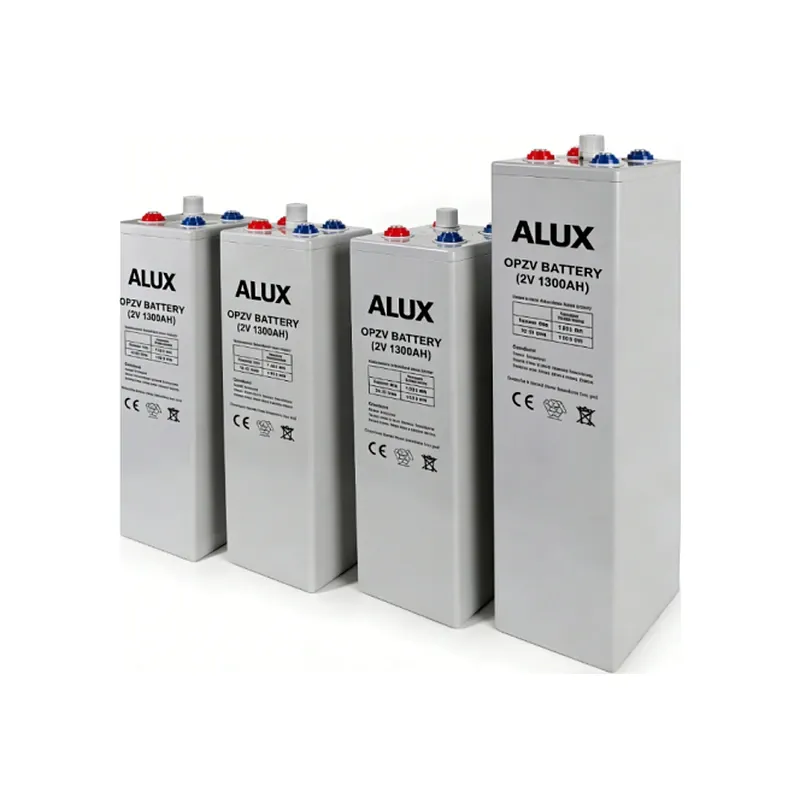
ALUX OPzV valve-regulated gel cells: sealed 2 V 1300 Ah cells need no watering and suit unmanned sites and cabinet installation.
The costs that never appear on the quotation
Comparing unit prices between an OPzS and an OPzV offer is close to meaningless, because the offers carry different scopes. Normalise to energy throughput:
Lifecycle cost per kWh throughput = (cell price × quantity + room and ventilation works + charger upgrade + lifetime maintenance labour and water + expected replacements) ÷ (usable kWh per cycle × cycles per year × years of service)
On the flooded side the hidden lines are the room, the ventilation work, water visits and records. On the gel side they are the higher unit price, the charger that must hold a tight window at low ripple, and the fact that a degraded string is normally replaced as a string rather than cell by cell. For a manned facility with a proper battery room, flooded frequently wins; for 200 remote sites with quarterly visits, the labour line alone usually decides it.
Choosing by site condition
Unmanned site, visits quarterly or rarer → OPzV. No watering, no specific gravity readings, non-spillable transport.Manned plant, trained technician, hot room → OPzS. Replaceable water, visible electrolyte, longer provable life when maintained.Daily deep cycling from solar, remote → OPzV, with a charger holding float within ±1% and publishing its ripple figure.Short, high-rate discharges → flooded tubular or AGM; gel has higher internal resistance and delivers burst current less readily.Cabinet with limited headroom → OPzV, subject to the manual permitting horizontal installation.Capex-constrained tender, room already built → OPzS, if the maintenance contract is real rather than nominal.
What to put in the RFQ so quotes can be compared
1. The duty cycle, not just the capacity. Daily depth of discharge, autonomy hours, load profile, cycles per year.
2. The C-rate behind the Ah figure. C10 and C20 ratings for the same cell differ; ask for both, with the end voltage used.
3. The cycle-life test basis. DoD, end-of-life capacity percentage, test temperature, discharge rate and the standard followed.
4. The electrolyte, stated explicitly. OPzS strictly means flooded and OPzV means valve-regulated gel. Some catalogues use the two designations loosely, or describe an OPzS cell as gel; the datasheet and the designation must agree before prices are compared.
5. Charge parameters and ripple limit. Float and boost voltage per cell at 20 °C, temperature compensation coefficient, maximum charge current, permitted ripple.
6. The report set. Type test reports to IEC 60896-11 or IEC 60896-21/-22 as applicable, plus IEC 61427-1 cycling data for solar duty.
7. Room data. Ambient temperature range, available ventilation, floor loading limit, installation position.
Incoming inspection: five checks before you sign
Capacity test. Discharge at the declared rate to the declared end voltage, correct to 25 °C, compare with nameplate. Sample across the string, not just the first cell.
Cell voltage spread after float. Leave 24 to 72 hours on float, then measure every cell. Valve-regulated cells should settle within about ±4.5% of the mean applied voltage; a flooded cell drifting more than 0.03 V from the string average needs attention.
Terminals and seals. Torque to the manufacturer's figure, inspect for acid seepage or gel exudation at the post seals, confirm connector bars sit flat.
Date code and storage charge. Confirm manufacturing date and open-circuit voltage; cells that sat in a warehouse for a year need a commissioning charge before any capacity test means anything.
Documentation. Test report with serial numbers, IEC certificate, installation and maintenance manual, and the commissioning record sheet you will use for the next ten years.
FAQ
Is OPzV better than OPzS?
Neither is better in general. OPzV removes maintenance and spill risk and suits unmanned sites; OPzS tolerates heat and overcharge better and gives a longer provable life where someone will maintain it. Site conditions decide.
Can an OPzS battery be installed on its side?
No. Flooded cells contain free liquid and must stay upright with vent caps on top. Only valve-regulated designs may be installed horizontally, and only where the manual allows it.
Do OPzV batteries need ventilation?
Yes — less than flooded cells in normal float service, but the room or cabinet still needs airflow and the charger must be temperature-compensated, because the valve vents gas under overcharge or fault.
How often do OPzS cells need water?
Two to three years between top-ups is typical in a temperate, well-regulated room on float. Hot rooms and daily cycling shorten that sharply, so record consumption per cell and treat a sudden increase as an early warning.
Can OPzV and OPzS cells be mixed in one bank?
No. Different float voltage requirements, internal resistance and ageing behaviour mean a mixed string is permanently either overcharged or undercharged.
Next step
If you are specifying a tubular bank for a solar, telecom or substation project, send the duty cycle, ambient temperature range and room constraints. We will come back with a cell recommendation in the right family, the charge parameters your inverter or rectifier needs, and the report set that ships with it. Contact the ALUX Renewable team with your project details, or review the ALUX OPzV 2 V 100 Ah and ALUX OPzS 600 Ah cell data before the first call.